How Monty’s Plant Food Is Helping Indiana Farmer Jason Evans Push Yield Potential and ROI
Jason Evans believes every acre should deliver a return. Farming 2,600 acres in Indiana — including 1,050 acres of corn and 1,550 acres of soybeans — Jason is focused on improving soil health, nutrient efficiency, and increasing ROI through precision fertility management. His operation includes both white and yellow corn, carefully managed to prevent contamination between crops.
Over the past few years, one of the biggest changes on Jason’s farm has been partnering with Monty’s Plant Food and adopting a more data-driven approach to crop nutrition.
“We’re always trying to fine-tune the system,” Jason explained. “I don’t want to just throw products at the field. I want to understand what’s happening in the soil and what’s driving the crop.”
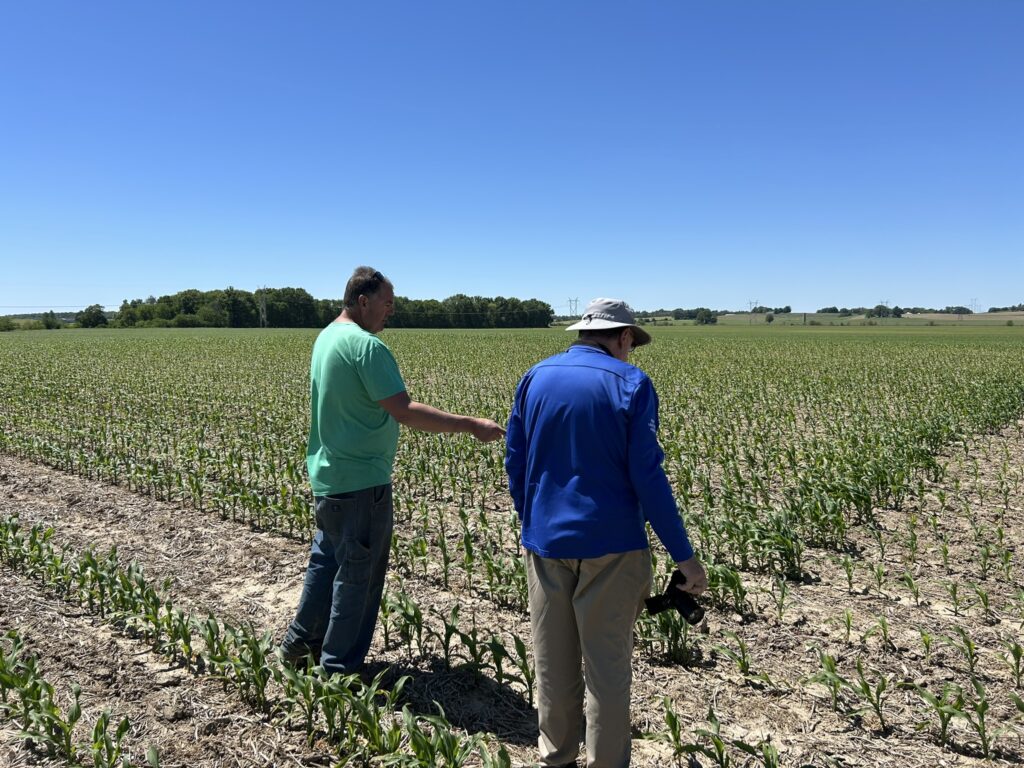
This season, Jason ran a Monty’s ProtoColl program on all his acres, but focused more heavily – higher rates — on 157 acres using his 24-row planter. One of the most noticeable moments came during planting when he stopped to refill seed. The overlap area received approximately 30% more ProtoColl, totaling about four gallons in that section.
“You could physically see the difference,” Jason said. “The corn where the overlap happened was taller, thicker, heavier, and noticeably healthier.”

For Jason, it was another clear example of the value biological crop nutrition and humic-based fertility programs can provide. He believes Monty’s products, paired with consistent testing and targeted nutrition, are helping move yields in the right direction while improving ROI.
Joe Dedman, Monty’s Vice President of Agronomy, says Jason’s approach reflects modern precision agriculture at its best.
“Jason isn’t guessing,” Joe said. “He’s using data, observations, and plant response to make decisions. That’s where Monty’s products really shine — helping unlock nutrient efficiency, improve root development, and maximize what’s already in the soil.”
Jason’s fertility program begins at planting with both in-furrow and 2×2 applications. In-furrow, he applies the unique, encapsulated ProtoColl 7 because of its 100% orthophosphate formulation, helping nutrients become immediately available to the developing crop.
“That orthophosphate availability was a big reason I chose ProtoColl 7,” Jason explained. “You want that crop feeding right away. And the encapsulation allows the nutrients to stays near the root zone for better uptake.”
His 2×2 program includes a balanced nutritional package containing nitrogen, phosphorus, potassium, zinc, manganese, boron, iron, copper, Agri-Sweet, and Monty’s Liquid Carbon. This placement strategy positions nutrients close to the root zone while minimizing salt stress on the seed. Around the V6-V7 growth stage, Jason follows with a Y-Drop application including nitrogen, MLC, zinc, manganese, sulfur, and potash to support rapid growth and nutrient uptake.
The layered fertility approach helps maintain nutrient availability throughout the season while supporting stronger root development, plant health, and overall yield potential.
One of the most unique aspects of Jason’s program is what he is not applying: dry fertilizer. This year, Jason is testing the impact of eliminating dry fertilizer entirely and has already noticed reduced salt pressure in the root zone.
“We’re seeing less salt issues by not running dry,” Jason said. “That’s something I’ve really noticed.
Joe believes Monty’s humic technology is playing an important role in that transition.
“Humics help buffer salts, improve nutrient availability, support microbial activity, and enhance overall soil health,” Joe explained. “When you combine that with a strong fertility plan and consistent testing, you create a more sustainable farming system that performs more efficiently.”
Jason was introduced to a dry humic product several years ago by a fellow farmer. He applied more than 300#s per acre and saw no results. He has now been using Monty’s activated humic technology for three seasons and says he has seen measurable improvements in nutrient availability, especially with micronutrients like manganese.
A major reason Jason feels confident making changes is his commitment to soil and tissue testing. He strongly advocates for testing because it allows him to make decisions based on actual field conditions instead of assumptions.
“You can’t manage what you don’t measure,” Jason said. “The testing tells the story.”
Jason soil tests one field each spring on a three-year rotation, rotating between Field 1, Field 2, and Field 3, and conducts tissue testing every two weeks during the growing season. The regular monitoring helps identify deficiencies early and fine-tune in-season applications. “Jason relies on sample results like these to make informed farming decisions.”
For Jason Evans, the combination of Monty’s Plant Food, agronomic support, and a data-driven mindset is helping position his operation for the future.
“We’re learning every year,” Jason said. “But I can honestly say we’re seeing the impact in the field and our ROI.”
For more information about Jason’s testing results, reach out to Joe Dedman ici. Learn more about Soil and Tissue testing ici.
For more information about Monty’s programs and products contact your Représentant de Monty.


 English
  Arabic
  Bengali
  Chinese
  French
  German
  Hindi
Hindi  Indonesian
  Portuguese
  Russian
  Spanish